

This article was created with the assistance of artificial intelligence to analyze Shorewood’s Reserve Policy against other city’s best practices. SCA will periodically bring readers a new article using artificial intelligence testing Shorewood’s policies, proceedures and practices.
We asked ChatGPT to review Shorewood’s Reserve Policy. In its simplest term, reserves are a savings account that the city holds in case of emergency. Shorewood City Council has adopted a Reserve Policy of 35% – 50% of next year’s expenses (ex. $8.0M budget = $2.8M – $4.0M in reserves).
Here is what ChatGPT had to say about the city’s reserve policy.
Shorewood’s 2025 Reserve Policy provides a reasonable framework for maintaining financial stability, but it has several important weaknesses that could allow the City to accumulate and retain more taxpayer and ratepayer money than is necessary.
1. No Meaningful Ceiling on Reserves
The policy establishes a 35%–50% “target” for unassigned General Fund reserves, which is substantial but defensible given cash-flow and emergency needs. However, when reserves exceed 50%, the policy says the excess “may be used” for projects, capital acquisitions, transfers, or other purposes determined by the City Administrator and/or Finance Director.
The policy therefore establishes a target, but not a firm maximum that requires Council action when exceeded.
2. “Maximum Reserves” Can Become Open-Ended
For Capital Project Funds and Enterprise Funds (water utilities), the policy says the maximum reserves should include amounts necessary for future capital projects, provided those projects are identified and quantified in the Capital Improvement Plan (CIP).
This creates a potential problem: the more future projects the City identifies, the more money it can justify holding. The policy does not establish a clear time horizon or require that reserves be tied to projects that are actually scheduled and funded.
3. Too Much Administrative Discretion
The policy delegates authority to the City Administrator to assign and remove fund-balance assignments. It also allows excess General Fund balances above 50% to be used for various purposes determined by the City Administrator and/or Finance Director. For significant amounts of taxpayer money, stronger Council oversight would improve transparency and accountability.
Note: Under MN Statute §471.57, when money in a permanent improvement or replacement fund exceeds what is necessary for its authorized purposes, the council can adopt a resolution declaring that excess and use it for other authorized municipal purposes. We recommend changing this language to read “the city council members must adopt a resolution declaring that excess…”
4. No Clear Policy for Excess Money
The policy is much clearer about how much money the City should have than about what should happen when it has more than it needs.
There should be a formal process requiring staff to identify excess reserves, explain why they exist, identify planned uses and timing, and present the options to the City Council. If the money is not needed for a legitimate future purpose, the City should consider reducing taxes, fees, rates, or future borrowing.
5. Annual Reporting Should Be More Transparent
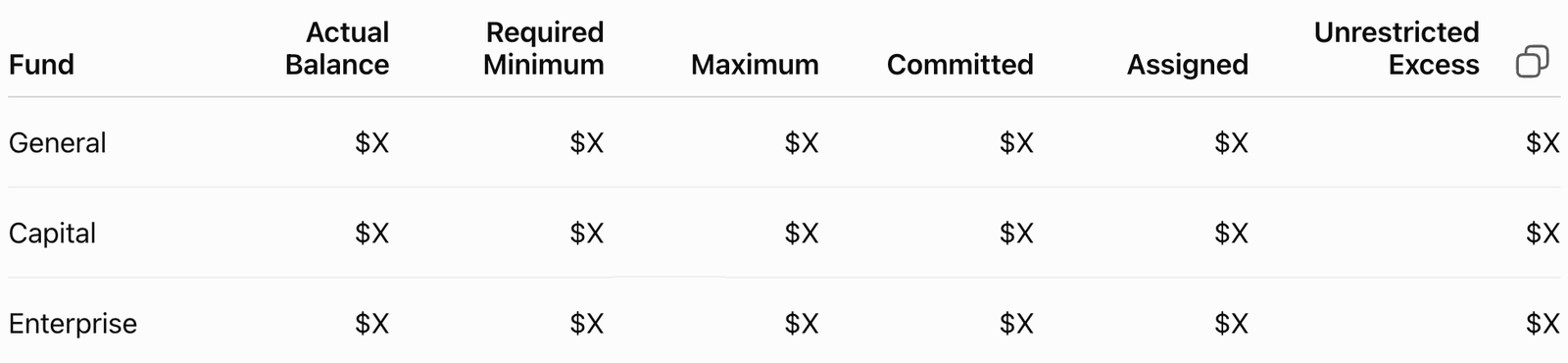
The policy requires the Finance Director to report annually on fund balances relative to the policy. That report should clearly show balances as shown in the example below for every fund:
Bottom Line
The policy is sound in concept but weak on limits and accountability. Its biggest deficiency is that it does not clearly establish when Shorewood has more money than it reasonably needs or what the City must do with that excess.
The key policy question for Council should be: How much money does Shorewood actually need to hold, and what should happen to money held above that amount? Please comment below.


