
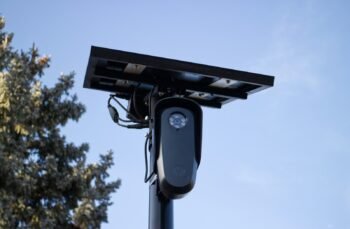
When SCA first covered Shorewood’s Flock ALPR cameras in fall 2025, few other examples of citizen resistance existed. Brooklyn Park would be canceling its contract in early 2026. Mankato residents were in an uproar, but the Flock cameras prevailed. The prominent success story was in the activist group DeFlockRedmond had success in Washington. That has changed. Citizen pressure, not policy handed down from above, is now driving the shift away from Flock nationwide.
Flock Safety’s automated license plate reader network of roughly 120,000 cameras across 49 states, faces a backlash led by citizen activists on legal, physical, and ideological fronts. It is working, but the pressure must stay on.
Backlash
People have cut down cameras with an electric saw in upstate New York, thrown paint on them in Oakland, California, and rammed a truck into them in Idaho. A Florida resident has sat in a lawn chair holding a piece of cardboard on a pole to block a camera’s view.
City councils are responding to that pressure. Stoughton, Wisconsin’s city council unanimously voted to terminate its Flock agreement just months after cameras went up. South Kingstown, Rhode Island, terminated its Flock contract in July. Earlier exits include Charlottesville, Fort Collins, Eugene, Madison, Knoxville, Syracuse, and Walla Walla. In cities where Flock has delayed removing cameras, officials covered them with trash bags.
Expanding reach
Flock is also quietly developing tools to expand its reach. 404 Media reported on July 22 that police have used Flock’s “FreeForm” search tool to find specific people with searches such as “heavy-set male with a black and white hat” or “person wearing orange vest and construction hat,” some may include a target’s race. FreeForm lets an agency query hundreds of cameras at once for a person. NOVA is Flock Safety’s newer AI-powered camera platform that uses video analytics to identify and track vehicles and other objects beyond traditional license-plate recognition. And there is the Flock DFR (drone first responder) technology. Both less visible than the cameras that sparked the backlash.
“If I’m not doing anything wrong…”
We have news for you, not doing anything wrong and think you have no worries? Roseville Police Department had over 1400 Flock alerts in two years. When the police department conducted an analysis, it found that 71% of those license plate alerts were misread by Flock’s software. Roseville police meet with Flock twice a month and the issue is ongoing. And, there is the Tennessee grandmother who was misidentified and spent six months in a North Dakota jail.
Star Tribune Investigates
A July 20 Star Tribune article found that despite state law limiting data, agencies left Twin Cities camera data accessible to other departments that searched it for immigration purposes during last winter’s federal enforcement surge. Crow Wing County has a working relationship with ICE and searched the data. The sheriff described the searches as “civil immigration enforcement.”
A July 31 Star Tribune follow-up found that Fridley had restricted data access after learning several agencies searched it hundreds of times for immigration purposes. While Flock says its policies do not allow one agency to share its account with another, sharing can happen unknowingly if a default setting is not changed. A Fridley City Council candidate called the camera network “a backdoor for civil immigration enforcement that our community never consented to.” In a May blog post, Flock said misuse of its system is rare and that audit logs help identify improper access.
Marci Bakely would disagree. The Washington Post found that a Georgia police chief, Michael Steffman, used Flock to search license plates belonging to Bakely and her teenage daughter roughly 600 times. He tracked Bakely’s grocery runs, dates, and doctor’s visits closely enough that he’d text her about them within minutes. He was arrested on stalking and harassment and died by suicide before trial. California prosecutors say a sheriff’s deputy had a month’s long stalking campaign against his former fiancée that included tracking her through Flock and planting a hidden camera in her roommate’s bathroom.
Flock’s “Pivot”
Flock CEO Garrett Langley called activist critics “terroristic organizations” and has now apologized. This came after the company sent cease-and-desist letters to the DeFlock mapping project and pursued the site HaveIBeenFlocked.com.
Flock says it ended its “human distress detection” which monitored public places for sounds of screaming. The Electronic Frontier Foundation says thousands of the listening devices remain installed despite cancellation.
After a Tennessee advocate flagged dangerously placed camera poles, Langley said the company had fixed 16 poles and launched a nationwide audit of its installations.
The FBI is soliciting bids for a contractor to give access to the national ALPR network, most of which is Flock’s. Flock is reportedly competing for that contract, which would offset the growing number of local cancellations with federal revenue. Substack writer Charles Hugh Smith wrote that surveillance is no longer solely a government function. Private companies collect the data and sell access to government agencies, removing privacy protections once it changes hands.
Company representatives describe the technology in basic terms: a car passes, a picture is taken, and a plate is read. They do not address back-door access, data storage, FreeForm search, or audio surveillance which is the areas where Flock’s next moves are likely to be least visible.
Minnesota has more restrictions on ALPR use than many states but is not among the most restrictive. There is no visible state-level lobbying campaign from Flock to protect its turf at this time, and no resolution to a recurring complaint that cameras often remain installed and are difficult to remove after a city cancels its contract, as seen in Evanston, Dayton, and Shorewood. Rep. Andrew Myers has had conversations with residents about their concerns, but it is unknown if he took any action.
Citizen action, not Flock goodwill, has forced every contract cancellation so far. As Flock and similar companies shift toward less visible tools, the public staying informed and engaged will determine whether that progress holds. Convincing elected officials is your only protection from Flock surveillance.
======================================================================
Sources:
- CNN, July 30, 2026: “Flock cameras are getting mobbed”
- WMTV, July 29, 2026: “Stoughton City Council unanimously votes to terminate agreement with Flock Safety”
- YouTube Tennessee Grandmother held in jail for six months
- ACLU: “Get the Flock Out”
- 404 Media, July 22, 2026: “How Cops Use Flock to Track People, Not Cars”
- Star Tribune, July 20, 2026: “Police searched Twin Cities license plate cameras for immigration enforcement during ICE surge”
- Star Tribune, July 31, 2026: “Twin Cities suburbs restrict license plate data after Star Tribune investigation”
- Washington Post, “How rogue officers turned a nationwide camera network into a tool for stalking.” Washington Post, August 2, 2026
- CounterPunch, July 16, 2026: “While the Political Circus Distracts Us, Flock Builds the Digital Police State”
- Substack, Charles Hugh Smith, July 29, 2026: “Get the Flock Out of Here”
- Forbes, July 17, 2026: “Flock CEO Apologizes For Calling Activists ‘Terrorists'”
- Futurism, July 2026: “In Light of Overwhelming Backlash, Flock Cancels Creepy Audio Surveillance Feature”
- WATE, July 2026: “16 Flock cameras fixed after Tennessee safety audit”
- Washington Times, July 2, 2026: “Public backlash explodes against mass surveillance cameras”
- GovTech: “Why Flock Safety Finds Itself in a Surveillance Backlash”
- ABC7 Los Angeles, July 2026: “Flock Safety CEO speaks out after LAPD suspends use of company’s surveillance cameras”
Was this post useful?
Average rating 4.9 / 5. Vote count: 8
No votes so far! Be the first to rate this post.


