
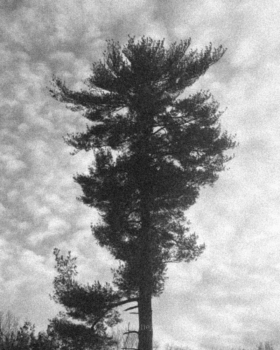
One hundred and twenty-five years ago, Henry Ford’s Model T was still seven years away. The Wright Brothers hadn’t flown. Women couldn’t yet vote. World War I was over a decade in the future. Shorewood itself wouldn’t be incorporated for another 54 years.
And a young eastern white pine was taking root at the corner of Birch Bluff and Eureka North.
Today, we introduce you to a very special tree. It’s a tree worth experiencing.
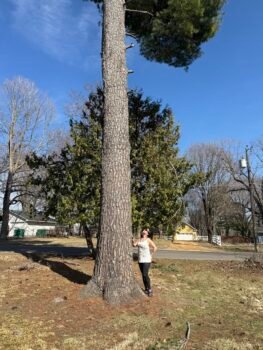
If you pass by in a car, you get a window full of trunk. To really take in its power and size, it is essential to get out of the car. Seriously.
And then…
Vertigo.
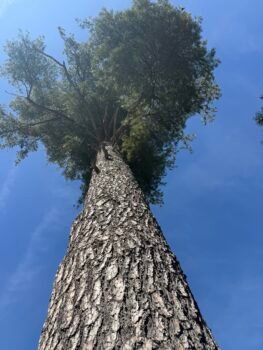
It’s the first sensation when bellying up to this giant eastern white pine towering ninety-four feet over the homes where Birch Bluff and Eureka North intersect.
Imagine craning your neck to see lush pine boughs spreading fifty-three feet wide, nearly one hundred feet in the air.
A basketball court stood on its end with a semi-truck trailer balanced on top.
This tree is magnificent. Perhaps even breathtaking, if you take the time to put a hand on its trunk.
At one hundred years old, Natural Historian & Writer, Sir David Attenborough’s mission still hasn’t wavered. It lives at the core of his prolific work as a natural historian and writer, and fuels our passion to be a better steward of the spaces we inhabit.
Sir David says:
“No one will protect what they don’t care about, and no one will care about what they have never experienced.”
Countless harmful decisions have passed muster by folks who don’t care. But Attenborough’s comment holds a measure of grace, too: “…what they have never experienced.”
Did you know this?
“A single large tree can host 20 to 50 bird species throughout the year, and a [single] mature tree can support 200 to 500 insect species on average.” -MN DNR
Even if you’re not a “nature type,” it’s difficult to dismiss its importance. Everything in our lives, from the food we eat to the bones of our houses, our clothing, and our medicines, comes out of the Earth. And those things depend on a balanced and biodiverse ecosystem.
And biodiversity depends on mature trees.
Plus, many people who lean more “city” still find themselves taking the family to the lake or up the mountain or into the woods for a much-needed vacation.
There’s a reason we return to the Earth when we need a break from it all.
Without biodiversity, we’d struggle as a species. And because of our knee-jerk decisions—yes, here in Shorewood, too—many species do.
If this eastern white pine were anything else, it would be in a museum.
Master Arborist, Don Mueller, had this to say after inspecting it:
“There is a strong argument for the historic value of this large, old white pine. The area around Lake Minnetonka was much different back when this tree was a seedling. It has been standing through years of drought and storm, it survived an exotic disease that killed thousands of other white pine, and it has watched rustic lake cabins give way to modern suburban homes. It’s unique in the area, and has become a local landmark. After all the changes and challenges this tree has stood through, and potentially with decades of life ahead, it would be a great shame to lose it now.”
And we might.
This tree sits smack in the middle of Shorewood’s Clara Avenue easement, part of the proposed Watten Ponds 2nd development area.
As of this writing, the future isn’t looking very bright for this tree.
“I found aerial photography taken in 1953. Although the images are grainy, the white pine on Eureka Road was clearly visible as a substantial tree 73 years ago. In my opinion, the tree is certainly over 100 years old, and it could easily have been growing before the start of the 20th century.” – Don Mueller, Master Arborist
Understanding and appreciating notable trees is important. They cannot be easily replaced, unless you plan on living more than a century.
A sapling or two as restitution for removing a mature tree isn’t fair payment. Here’s why:
Research now shows that the oldest trees store the most carbon, shelter the most species, regulate nutrients and stabilize local climate—ecosystems within ecosystems, often more important than the rest of the forest combined.*
This pine is a rare feature of our landscape. A true historical landmark.
We can dream of living in a community where the importance of mature trees as a vital part of a healthy ecosystem isn’t up for debate.
A community where working with the land is a priority, even if it takes a little more planning when new construction starts.
An invitation: Go visit this incredible tree. Put a hand on its trunk and take a deep breath. Maybe even thank it for helping to make Shorewood (even before it existed as a city) a little bit more beautiful and biodiverse for well over 100 years.
Natalie Jennings is a second generation Shorewood Resident
Sources:
Master Arborist Don Mueller, official report
OneMoreTree.org,
Eastern White Pine, Minnesota DNR
Was this post useful?
Average rating 4.8 / 5. Vote count: 25
No votes so far! Be the first to rate this post.


