
Updated coverage building on SCA’s original February 2025 report
Mystery Machine
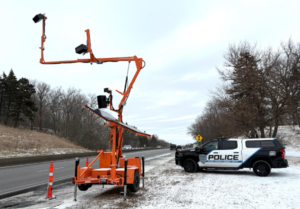
SCA first noted the curiosity generated by an orange trailer-like apparatus that appeared in Feb. 2025 along Hwy 7 near Excelsior. The structure remains, originally as part of a $450,000 grant awarded to the then newly formed Highway 7 Safety Coalition.
That original SCA post was short, pointing to a KSTP story. What residents now know is that the “orange thing” was the first deployment in Minnesota of the Acusensus Heads-Up Real-Time Enforcement System, an AI-powered camera platform that detects two things as vehicles pass: a driver holding a phone, and a driver not wearing a seatbelt. When it catches a probable violation, it sends photos to an officer stationed further down the road within about five seconds, letting them decide whether to initiate a stop.
South Lake Minnetonka Police Sergeant Adam Moore, who leads the project, pursued the funding after a 2022 push for the state to conduct a safety audit on Hwy 7. That audit found real deficiencies. Hwy 7 had already been trending dangerous. With five fatalities, 2024 turned out to be the deadliest year on record for the corridor…
What was learned
The Safe Road Zone Grant officially concluded June 30, 2025. During that time, the Acusensus system and the coalition’s broader enforcement push produced impressive results:
- More than 1,200 stops for suspected distracted driving
- Roughly 300 stops for seatbelt violations
- A fourfold increase in enforcement activity over prior yearly averages
- Zero fatal crashes on Highway 7 in all of 2025, down from five the year before, and serious-injury crashes fell to their lowest level in more than five years.
About Acusensus and how it works: Acusensus is headquartered in Melbourne, Australia. Its roadside cameras use artificial intelligence to analyze high-resolution images of passing vehicles for signs that a driver is using a handheld phone or failing to wear a seat belt. After the camera captures a possible violation, identification typically works like this:
Importantly, Acusensus itself does not identify the driver by name or use facial recognition. The system identifies the vehicle through its license plate. Any connection between the plate and a person’s identity is made by the government agency with access to motor vehicle records. Unlike traditional license plate readers, Acusensus is designed to detect driver behavior, not to track where vehicles travel. |
About funding:
The grant funding ended June 30, 2025. For roughly eight months after that, SCA has been able to locate public reporting from local news, or from any of the four SLMPD member cities about the program’s future.
Then, March 6, 2026, the SLMPD Coordinating Committee which is the four-mayor body that governs the department, held a special session specifically to approve an item titled “Acusensus Gifted Use Agreement & Resolution 26-01.” The entire meeting lasted eight minutes. Only three of the four member cities’ mayors were present for the vote. Greenwood’s mayor was not. The agreement was approved with essentially no recorded discussion beyond a single clarifying question about its effective date May 1, 2026.
Questions worth asking
- What were the terms of the “gift?” Are there strings attached involving data-sharing, marketing use or other considerations?
- Is there a written policy governing image retention, who can access the captured photos, and how long they’re stored?
- Why did this item receive minimal public discussion before approval, even for a program with a strong safety record that would likely withstand real scrutiny?
None of these questions imply the program is a problem. The safety data speaks for itself. In this case, a good outcome was arrived at with almost no visible public deliberation by the body legally responsible for its oversight.
Here are three commonly cited advantages and three commonly cited concerns about Acusensus.
Pros
- Improves road safety. By detecting handheld phone use and seat belt violations, the system targets two leading contributors to serious crashes and can encourage safer driving.
- Efficient enforcement. Cameras can monitor thousands of vehicles each day, allowing law enforcement officers to focus on other public safety duties.
- Human verification. AI only flags potential violations. A trained human reviews the images before a warning or citation is issued, reducing the likelihood of false positives.
Cons
- Privacy concerns. The system captures images of every passing vehicle, including drivers who have done nothing wrong. Critics question the collection and temporary storage of those images.
- Potential for errors. Although reviewed by humans, the technology can sometimes misinterpret objects or driver actions, resulting in disputed violations.
- Cost and public acceptance. The systems can be expensive to purchase and operate, and some residents object to automated enforcement because they believe it expands government surveillance or should require greater public oversight.
The debate generally comes down to road safety versus privacy: supporters emphasize the potential to reduce distracted driving and save lives, while critics focus on surveillance, data handling, and government accountability.
Compared with most states, Minnesota has some of the strongest statewide privacy protections governing automated license plate readers (ALPRs). While many states have few or no statewide restrictions, Minnesota has enacted detailed rules on data retention, access, sharing, audits, and public accountability.
Where Minnesota law is especially strong
- Limits retention of non-investigative ALPR data to 60 days.
- Restricts who may access ALPR data and for what purpose.
- Requires independent audits and public reporting.
- Prohibits sharing ALPR data with unauthorized entities.
SCA will continue following this story and will update as more information becomes available.
Sources:
SLMPD Agenda and Minutes, Mar. 6, 2026
AI Technology for Distracted Driving, SCA, Feb. 25, 2025
Was this post useful?
Average rating 4.8 / 5. Vote count: 11
No votes so far! Be the first to rate this post.


