
Revised December 21, 2025

Keeping Flock on the Radar
The Nov. 10 Shorewood MN work session revealed critical information about the Flock cameras hovering over not only the South Lake area, but the entire country.
There is daily coverage focusing on local government actions and civilian concern and experiences because of Flock cameras watching our movements.
Recent articles:
- Secretive Border Patrol program is detaining US citizens for ‘suspicious’ travel
- A Vast Camera System
- Why I Voted to Cancel Flock
What you can do:
- Ask your city leaders to be transparent about any Flock cameras in the community
- Speak up at council meeting public comment periods.
- Give a copy of your prepared remarks to the council and ask it to be part of the public record.
- Stay diligent, expect answers and accountability.
14 Lake Area Mayors Consider a Lobbyist
Under the premise that Lake Minnetonka area cities pay more in taxes than they recover in services, Wayzata Mayor Andrew Mullin has sent a memo to the mayors of the 14 cities surrounding the lake suggesting the group hire a lobbyist to represent their issues at the Legislature. Specifically, he suggested pooling $50,000 to retain John Berns of Carnival Berns, P.A. Most, if not all, of the 14 cities are current members of the League of Minnesota Cities (LMC), which also provides lobbying advocacy.1
Mayors Bob Tunheim of Orono and Joe Pagano, Minnetonka Beach are supporting the concept. The 14 cities to receive the memo include: Deephaven, Excelsior, Greenwood, Minnetonka, Minnetonka Beach, Minnetrista, Mound, Orono, Shorewood, Spring Park, Tonka Bay, Victoria, Wayzata, and Woodland.
“Most of us are very small communities that don’t have a lot of clout with even our local representative, much less the Legislature,” – Mayor Joe Pagano, reporting to the Minnetonka Beach city council, Nov. 10.
Mullin outlined the perceived advantages of having a dedicated lobbyist:
- Save money on duplicative requests.
- Initiate better responses to shaping legislation.
- Build deeper government connections.
- Protect local control in zoning and land-use regulations
- Ensure property tax stability through maintaining authority
Mullins’ memo suggests pooling $50,000 for the lobbying services of John Berns of Carnival Berns P.A. Before any plans are finalized, the mayors must garner support from their councils to approve the expenditure.
____________1The LMC website states: “As a lobbyist, the League of Minnesota Cities (LMC) promotes excellence in local government through advocacy, expert analysis, and guidance for all Minnesota cities. Its core lobbying function is to represent the collective interests of its over 800 member cities at the state and federal levels.”
Source:
League of MN Cities website
Talking Turkey
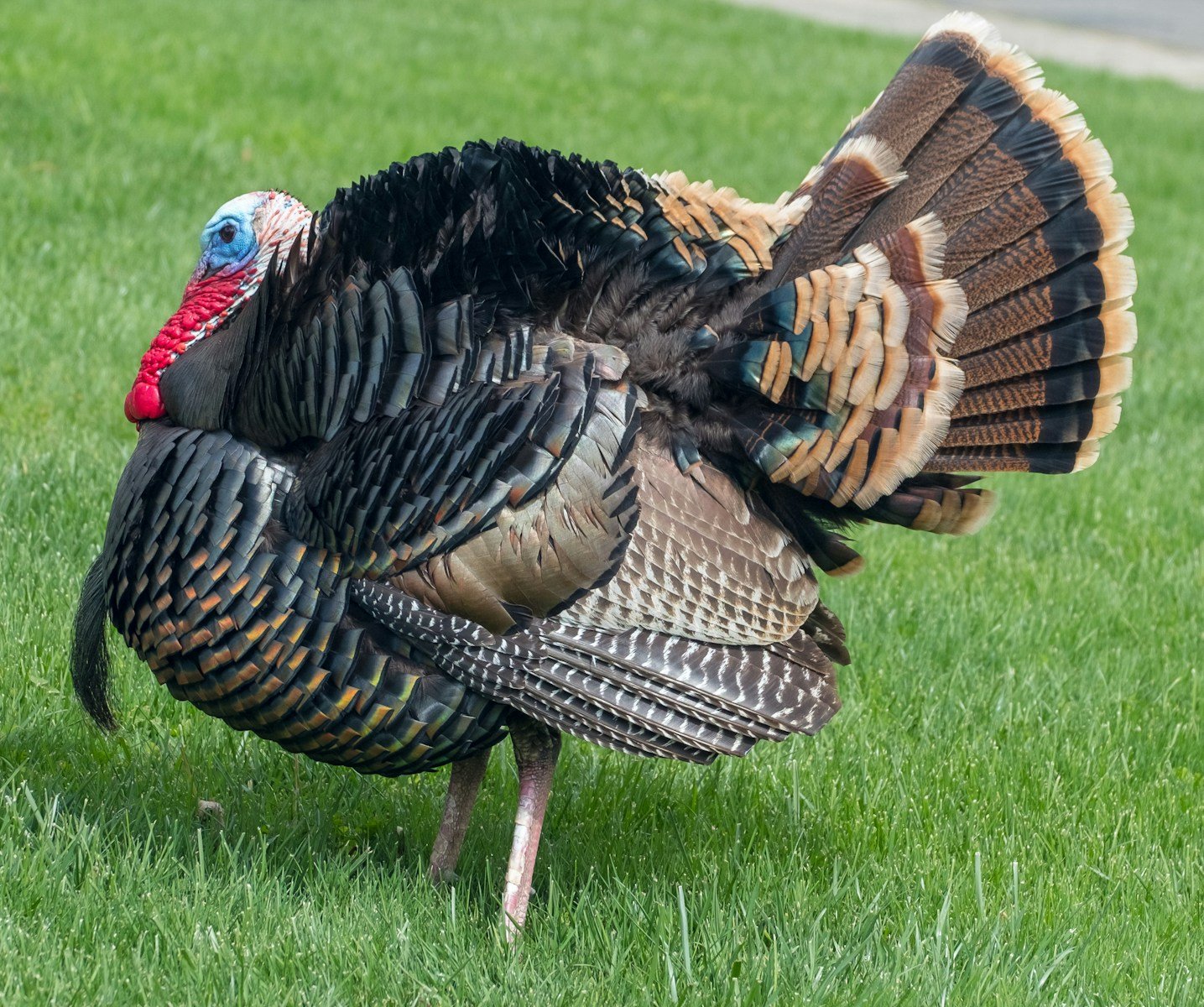
Stating the obvious: Wild turkeys are thriving in the suburbs. Opinions vary about sharing the neighborhood with the massive birds, especially as their numbers increase. While some humans revere them, others are not so fond of the avian invaders. That aside, turkeys provide notable environmental benefits.
The wild turkey is native to the eastern U.S. where, before colonial settlement, millions of them roamed. By 1930, logging, agriculture, and overhunting had just about eliminated the bird in the eastern states. As a result, hunting regulations and land management practices changed to restore the turkey population. The early 2000’s saw a surge to seven million birds now roaming 49 states.
Turkeys are a resilient bird proven to be quite adaptable to many suburban and urban areas. Adult males are called toms or gobblers, and the juvenile males are called jakes. The female adult turkey is called a hen, and a juvenile female is called a Jenny. Hens have a blue-gray head while gobblers have shades of red, blue, and white. The males have fleshy head and neck ornaments called caruncles, dewlaps, and the snood. Besides this, males have a group of coarse feathers hanging off their breast called a beard. A longer beard generally indicates an older, more mature male. The life span of a turkey is generally 2-5 years, some living up to 10 years. A high percentage of hatchlings die in their first few weeks, mainly from predators.
In the spring, toms compete for hens by using their sharp spurs to fight each other and fanning their beautiful tails in front of the hens. Hens are attracted to the toms’ colorful fleshy appendages. The snood is a fleshy bump on the dorsal surface of the beak just near the eye. Snoods are unique to turkeys and studies have shown that hens will choose a tom with the longest beard.
Courting toms gobble loudly to attract hens. They can be heard up to a mile away. Toms mate with multiple hens and do not help with nest building or raising the poults. The hens only have one brood per year. The chicks travel with their mother and often combine with other family groups. Wild turkeys provide a source of food for many wildlife and are therefore under constant threat of predation. Bobcats, coyotes, raccoons, mountain lions, eagles, owls, and people hunt turkeys. Opossums, skunks, snakes, rodents, and a variety of birds will rob the nests.
Turkeys have nitrogen-rich droppings that help nourish the soil. In addition, turkeys are an “indicator” species. Their presence or absence can be an indicator of forest health. Thriving turkey populations suggest a robust and diverse ecosystem.
The Minnesota DNR manages the turkey population and authorizes licensing for seasonal hunts. To minimize turkeys on your property:
- Avoid feeding them, they are naturally always grazing.
- Remove bird feeders.
- Scare them away with loud noises, spray from a hose or install motion-activated sprinklers.
- Remove shiny objects that may attract them.
- Antagonizing turkeys could result in a face-to-face with a protective “tom” from the flock.
As the birds sweep silently through neighborhoods, completely unaware of any boundaries, humans can be assured those birds are a sign of a healthy ecosystem.
Sources:
Chipco Preserve
Mendocino County Resource Conservation District
Minnesota DNR
Was this post useful?
Average rating 5 / 5. Vote count: 11
No votes so far! Be the first to rate this post.


