

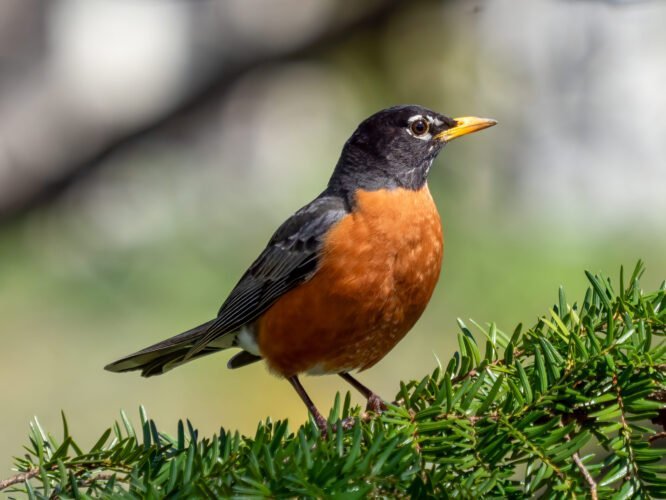
Reliable Robins Facts
Robins reliably amuse humans year round almost anywhere south of Canada. The map shows the birds breed from Canada to the north slope of Alaska, leaving in fall for the U.S. In central Minnesota, robins are present year around where water is available. Some winter in the Southwest, Mexico, and the Gulf Coast.
Why are robins able to survive the cold?
- Fluffing Feathers: They puff up feathers to create insulating pockets that hold in heat.
- Communal Roosting: They gather in dense, groups in thickets or evergreens to share warmth and protect against predators.
- Specialized Circulation: Their legs have a countercurrent heat exchange system where warm blood flowing down to the feet heats up the cold blood returning to the body.
- Tucking Legs/Beak: They often stand on one leg, tucking the other into their feathers, and hide their beak in their feathers for warmth.
Male American Robins are best identified by their brighter, more vibrant orange-red breasts, darker blackish-gray heads, whiter throats and are slightly larger than females. Females are more muted, pale, or “washed-out” with lighter brown-gray heads.
Female American Robins singing is generally less frequent and less varied than that of males, particularly during the spring breeding season. Both sexes sing to defend territory, and females are known to sing, especially during autumn and winter to protect food sources.
American Robins typically raise two to three sets of babies (broods) per breeding season, which lasts from April through July. Each brood consists of 3 to 5 baby blue robin eggs hard to miss. The small eggs hatch in about two weeks. Successful pairs potentially produce up to 15+ offspring in a single year. Both parents pitch in to feed the hungry hatchlings-making up to 100 trips a day. Baby robins grow fast. Within 14 to 16 days after hatching, they are ready to leave the nest and try flying on their own.
Robins are an indicator species, meaning their health gives scientists clues about the health of the environment. They were among the first birds affected by the pesticide DDT, which caused widespread die-offs. After the chemical was banned in 1972, robin populations bounced back quickly. Since robins eat many worms and insects from the ground, limiting pesticide and herbicide use helps keep them thriving.
Although their mating ritual includes a dramatic “spinning” dance, robin “love stories” are short. Like other backyard songbirds, they are often monogamous once they’ve paired up in spring… They go their separate ways when the family-raising season comes to a close. Separate or in pairs, robins can be counted on to keep their human counterparts entertained.
Read:
Northern Woodlands, 2023
Birds & Blooms, 2024
Listen:
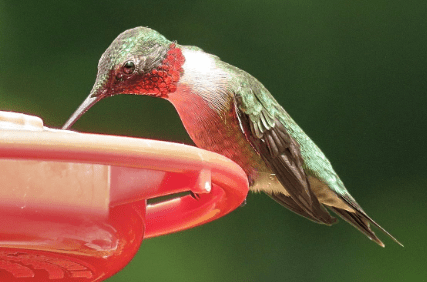
Hummingbird and “Snowbird” Migration
As sure as it is spring, our avian friends are heading north from their winter perches. Factoids about the hummingbird migration, courtesy of HummingbirdCentral.com:
- During migration, a hummingbird’s heart beats up to 1,260 times a minute, and its wings flap 15 to 80 times a second.
- To support this high energy level, a hummingbird will typically gain 25-40% of their body weight before they start migration in order to make the long trek.
- They fly low just above tree tops and water, and alone, often on the same path they have flown earlier in their life. Young hummingbirds must navigate without parental guidance.
- They are also experts at using tail winds to reach their destination faster and by consuming less energy and body fat.
- A hummingbird can travel up to 23 miles in one day. However, during migration as they cross the Gulf of Mexico they may cover up to 500 miles at a time. Their average speed in direct flight is in the range of 20-30mph, and up to three times that fast during courtship dives.
Track their spring 2026 migration progress:
Other species heading to Minnesota mostly travel at night. Track them as they make their nocturnal flights over Hennepin County with the fascinating data provided at birdcast.org.
Additional resources:
MnDNR Guide for Feeding Hummingbirds
Cornell Lab of Ornithology
Cornell Bird Cams
Cornell Merlin Sound ID and Photo ID

LIVE Eagle Cams
Watch two nests live. Ft. Vrain, Colorado, and Twin Cities, MN. The nests are massive, typically measuring 4 to 7 feet in diameter and 3 to 6 feet in depth, often weighing over 1,000 pounds. Because eagles add new material to the same nest annually, they can grow exceptionally large over time, with record-setting nests reaching 9.5 feet wide and up to 20 feet deep.
Was this post useful?
Average rating 5 / 5. Vote count: 13
No votes so far! Be the first to rate this post.


