
Note: This content has been archived and may no longer be accurate or relevant
Some video links may have expired
‘Tis the season. Here are some conversational topics to keep things light, to learn and to share some humor.
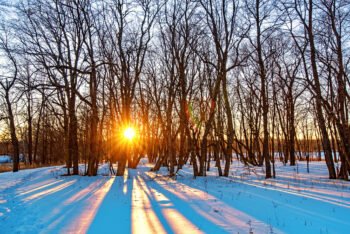
Winter Solstice
Dec. 21 is the winter solstice here in the northern hemisphere. How many are aware of this or have much of an idea of what it might hold for us? Do we know much of anything beyond it being a time of shortest sunlight and longest night?”
In the Northern Hemisphere, the 2025 winter solstice — the exact astronomical moment when the North Pole is tilted farthest from the Sun, occurs at 9:03 a.m. CST. On this day, we experience the shortest day: 8½–9 hours of daylight and longest night of the year. EarthSky
This moment is an instant in time — the precise point of the solstice — rather than a period that lasts hours. After that point, the amount of daylight in the Northern Hemisphere begins slowly, with daily increase measured in seconds. The coldest weather usually comes weeks after the solstice due to thermal lag.
- The word solstice comes from Latin solstitium, meaning “sun stands still.”
- The sun will be 15 million miles closer to earth than it will be at the equinox.
- The sun does not rise at all at the Arctic Circle on the winter solstice, and it does not set in the Antarctic.
Ancient cultures have observed solstices for at least 20,000 years, and could predict the solstice with remarkable precision, often using stone alignments and shadow tracking.
Germanic/Nordic
- Yule log: A large log burned over several days, it provided heat and light and represented endurance and protection.
- Evergreens indoors: Pine, fir, and spruce signaled life persisting through winter—an early form of the Christmas tree.
- Feasting: Not excess for its own sake—this was a planned drawdown of stored food before the deepest winter.
Key takeaway: Gather, conserve resources, and mark the fact that the sun is returning—even if conditions are still brutal.
Plains and Woodland Indigenous Nations (including Anishinaabe)
- The solstice often marked a midwinter period of storytelling.
- Oral histories, teachings, and moral stories were shared when the land was dormant and people were indoors.
- Winter was the season for knowledge transmission, not inactivity.
Key takeaway: The solstice was about alignment—with the sun, the land, and social obligations—not spectacle.
Modern, practical reflection
When taking away the mythology, the solstice message is blunt and useful:
- Take stock of what you have.
- Stay connected.
- Conserve energy.
– Portions of this article contributed by SCA reader D.C.
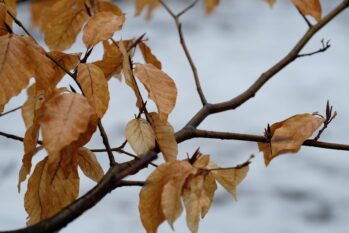
Some Trees Refuse to Let Go
Enjoy the sound of crisp leaves clinging to branches all winter? Or annoyed when they finally let go in spring—triggering another round of raking?
Those stubborn leaves belong to marcescent trees. In marcescence, leaves die in the fall but don’t drop. Instead, they hang on through cold and wind, only releasing when new spring growth pushes them off.
In Zone 4, the most common marcescent trees are:
- Bur, red or pin oak
- American Beech
- Ironwood / Hophornbeam
Useful facts:
- Marcescence is more common in young trees; mature trees often shed leaves normally.
- Botanists still debate its advantage, with leading theories including bud protection, snow capture, and nutrient cycling.
- Marcescent trees stand out in winter landscapes, their papery tan leaves clinging on while everything else is bare.
Source: MN DNR

Was this post useful?
Average rating 5 / 5. Vote count: 9
No votes so far! Be the first to rate this post.


